


Smart CCTV Features Transforming Home Security Today
Smart CCTV describes modern security surveillance cameras that combine high-quality imaging, networked connectivity, and AI-powered analytics to detect and respond to security events proactively. These systems work by capturing video with advanced sensors, processing frames locally or in the cloud using computer vision and machine learning models, and delivering real-time alerts to homeowners and managers to reduce false alarms and speed response. The result is improved detection of people, vehicles and suspicious objects, richer evidence for investigations, and greater peace of mind for residents. This article explains the core AI-powered CCTV functionalities, how real-time alerts and storage choices affect data security, which advanced camera features materially improve image quality and user interaction, and how homeowners and businesses should prioritise features. Read on for practical checklists, comparative EAV tables, privacy and deployment guidance, and a short framework for selecting and installing the right smart CCTV system for your needs.
How Are AI-Powered CCTV Systems Revolutionizing Home Security?

AI-powered CCTV systems shift surveillance from passive recording to proactive detection by applying to live video streams for immediate classification and prioritisation. These systems analyse motion patterns, recognise people and vehicles, and flag anomalies such as loitering or line-crossing so that only actionable events generate alerts, which reduces monitoring load and false positives. By integrating analytics with remote access and cloud or hybrid storage, AI CCTV turns recorded footage into searchable, structured incident data that improves investigations and response times. The next subsections unpack the analytics building blocks, motion-detection improvements, facial recognition roles, and object-detection capabilities that underpin this transformation.
AI-powered analytics make CCTV smarter by converting pixels into semantic events through models trained on person, vehicle and behaviour classes. This workflow — camera → analytics module → alert — enables systems to detect relevant activity and suppress environmental noise like shadows or swaying trees. The practical outcome is fewer false alarms and for homeowners and monitoring centres. Understanding analytics mechanics leads naturally to how motion detection has evolved.
AI enhances motion detection by classifying movement rather than simply measuring pixel change, enabling it to distinguish people from pets or foliage. Modern systems apply background modelling and object classification so that only movement matching defined classes triggers notifications, which reduces alert fatigue and improves operator focus. Configuration best practices include drawing motion zones, setting sensitivity, and calibrating thresholds for typical household activity. These configuration steps segue into the role plays in enabling trusted access and watchlists.
Facial recognition in smart CCTV serves identification and verification roles: it can tag known household members or authorised personnel and raise alerts for unknown or watchlisted individuals. On-device face matching combined with opt-in enrolment protects privacy by keeping identities local while still providing immediate context for alerts. Accuracy depends on sensor quality, lighting and model training, and privacy safeguards such as selective retention and consent mechanisms are essential. Having covered identification use-cases, the next section explores object detection and its direct security benefits.
Object detection expands CCTV capabilities beyond persons to include vehicles, packages and other items, enabling automated workflows like package-notification or vehicle tracking across perimeter cameras. Multi-class detection uses bounding-box predictions and confidence scoring to generate context-rich alerts that aid incident verification and evidence collection. For
homeowners, object detection supports package monitoring and driveway monitoring, while for larger sites it assists in vehicle analytics and parking enforcement. These object-level insights provide actionable data that improve both deterrence and investigation outcomes.
This comprehensive review delves into the intricacies of object detection, a fundamental component of modern surveillance systems, and its evolution with security surveillance cameras.
Object Detection for Security and Surveillance: A Review of Artificial Intelligence Techniques
In recent years, object detection (OD) has become indispensable in computer vision for identifying and localizing objects within digital images, leading to its widespread adoption across various sectors. However, the increasing reliance on OD has also exposed vulnerabilities to adversarial attacks, underscoring the critical need for robust detection methods to mitigate potential risks. Consequently, this paper primarily surveys existing studies on OD within the domain of security and surveillance, emphasizing its significance in these crucial applications. The discussion encompasses an examination of conventional techniques such as Histograms of Oriented Gradients (HOG), Deformable Part Models (DPM), and the Viola-Jones detector. While these traditional methods have established the foundation for object detection, they are often deemed insufficient due to their time-consuming and labor-intensive nature. Therefore, the focus shifts to Deep Learning (DL)-based OD models, including YOLO (You Only Look Once), Single Shot Detector (SSD), and Fast R-CNN. Among these, the present survey paper highlights YOLO models for their speed and efficiency, as their unified architecture for both region proposal and classification makes them particularly well-suited for real-time applications.
Comprehensive study on object detection for security and surveillance: A concise review, F Alamri, 2025
Key AI-powered CCTV benefits:
- Proactive detection: analytics identify threats before escalation.
- Reduced false alarms: classification filters environmental noise.
- Structured evidence: tagged events speed review and response.
These capabilities are best evaluated alongside alerting and remote monitoring options, which we discuss next.
What Are the Benefits of Real-Time CCTV Alerts and Remote Monitoring?
Real-time CCTV alerts and remote monitoring change security dynamics by enabling immediate verification, remote deterrence, and faster escalation to emergency services or neighbours. Push notifications, SMS and email alerts that include short video clips or snapshot summaries let homeowners confirm incidents quickly and decide on appropriate action. Remote monitoring also supports live view and multi-site playback, allowing users to check footage from any authorised device and maintain oversight without being on-site. Below we examine crime prevention mechanics, the emotional benefit of remote monitoring, and the device ecosystem that supports these capabilities.
Real-time alerts help prevent crime by enabling immediate human verification and intervention, such as speaking through a two-way audio channel to deter intruders or instructing a neighbour to check on a property. Studies and operational reports show that rapid verification plus visible deterrence often interrupts theft attempts and reduces loss severity. For routine incidents like package deliveries, alerts enable timely retrieval and reduce opportunistic thefts. Understanding these response mechanics leads naturally to how remote monitoring improves homeowner peace of mind.
This research highlights the foundational aspects of real-time video surveillance, focusing on motion detection and alert capabilities, which are crucial for effective security systems.
Real-Time Video Surveillance System with Motion Detection and Alerting Capabilities
ABSTRACT: In the ongoing efforts to combat crime and terrorism, governments deploy video surveillance systems, functioning as ubiquitous monitoring tools in locations such as airports, ports, major roadways, government buildings, and critical infrastructure. However, conventional surveillance systems often exhibit hardware dependency and incur substantial installation costs. This paper focuses on the development of a web-based real-time video surveillance framework. The proposed many-to-many real-time surveillance system enables users to dynamically integrate their digital imaging devices, including webcams and CCTV cameras, via the Internet without requiring additional software installation. Furthermore, the implemented system incorporates an adjustable motion detection feature capable of initiating video recording and delivering real-time email notifications through a PC or 3G mobile messaging.
The development and applications of the remote real-time video surveillance system, 2010
Remote monitoring increases peace of mind by providing constant visibility into property status and enabling on-demand checks of children, pets or service workers via mobile apps. Customisable notification tiers (critical vs informational) reduce alert fatigue while ensuring urgent events stand out. Scheduled checks, event timelines and searchable incident logs all add to user confidence by making footage accessible and manageable. The devices that support this experience vary, and the next subsection outlines common clients and network requirements to ensure reliable remote viewing.
What devices support remote access? Most smart CCTV platforms use native iOS and Android apps, web portals for desktop access, and dedicated NVR client software for professional installations. Bandwidth requirements depend on resolution and frame rate — HD streams require modest upstream capacity while 4K streams need more — and local network quality affects latency in two-way audio. Integration with smart assistants and hubs may be possible through cloud-to-cloud APIs or local integrations, enabling voice-activated viewing and automations. Knowing supported devices and network needs helps when choosing and storage strategies, which we cover in the next section.
Real-time alert :
- Crime deterrence through immediate verification and intervention.
- Faster evidence capture with time-stamped clips and snapshots.
- Remote control for two-way audio and system management.
How Does Cloud Storage for Security Cameras Enhance Data Security?

Cloud storage for CCTV offers off-site redundancy, centralised management and simplified sharing for investigations, improving data resilience compared with single-point local storage. Encrypted uploads, managed retention policies, and provider-side backups protect footage from on-premise theft or hardware failure. That said, local storage preserves privacy and avoids ongoing subscription costs, and hybrid architectures combine both approaches to balance availability, cost and privacy. The table below summarises the trade-offs between cloud, local and hybrid storage to help homeowners and businesses choose the right strategy.
Compare common and their primary attributes.
| Storage Approach | Characteristic | Practical Impact |
|---|---|---|
| Cloud storage | Off-site redundancy and managed retention | Resilient to local theft or damage; easy remote access |
| Local storage (NVR/DVR) | On-premise control, no ongoing subscription | Greater privacy and lower recurring costs; vulnerable to device theft |
| Hybrid (local + cloud) | Local for immediate access, cloud for backup | Fast local playback plus off-site backups and selective retention |
This comparison shows that hybrid solutions often offer the best balance for homeowners seeking convenience and . The next subsections unpack cloud advantages, when local storage makes sense, and how hybrid systems are typically configured.
Cloud storage advantages include automatic off-site backups, centralised management for multiple cameras, and accessible playback from authorised devices without exposing local networks. Providers typically offer configurable retention windows and automated deletion policies that assist compliance and privacy management. Encryption in transit and at rest is a key provider responsibility, and homeowners should evaluate provider security practices and data access controls. Given cloud benefits, there remain scenarios where local storage is preferred.
Local storage is preferred when privacy, regulatory constraints or limited bandwidth make off-site uploads impractical; examples include sensitive home offices or rural sites with metered upstream connections. Local-first strategies avoid subscription fees for basic retention and preserve full control over footage access. However, local storage is vulnerable to device theft and hardware failure, so pairing with periodic off-site backups or physical security measures is advisable. These considerations motivate hybrid architectures.
Hybrid storage solutions combine local, immediate access with selective cloud archival for redundancy and long-term retention, optimising for cost, privacy and reliability. Common setups store recent footage locally for instant playback and send confirmed incidents or daily/hourly snapshots to the cloud for off-site retention. Policy recommendations include retaining high-confidence alerts in the cloud and keeping raw continuous footage local for a limited window, which balances privacy and investigatory needs. With storage decisions clarified, we next explore camera features that improve image quality and interaction.
What Advanced Features Should You Look for in Smart Home Security Cameras?
Selecting cameras with the right advanced features materially improves both detection accuracy and the usefulness of captured evidence. Key capabilities include high-resolution sensors, color night vision, two-way audio, reliable AI analytics and integration options with smart home platforms. Balancing image quality, connectivity and power requirements ensures the selected cameras meet the household’s operational and privacy needs. An EAV-style table below summarises prominent advanced features, how they work, and their primary benefits for typical home use-cases.
Advanced camera features explained for security surveillance cameras.
| Feature | How It Works | Benefit & Use-Case |
|---|---|---|
| Color night vision | Low-light sensors + supplemental illumination | Identifies clothing and plate colors at night; improves evidence quality |
| Two-way audio | Built-in microphone and speaker with low-latency streaming | Remote deterrence and instructing delivery drivers |
| AI analytics (person/vehicle) | On-device or cloud ML models classify objects | Reduces false alerts and enables targeted notifications |
| Integration APIs | Cloud-to-cloud or local API endpoints | Automations with lighting, locks and voice assistants |
This feature summary helps homeowners prioritise which capabilities map to their security goals. The following H3s describe color night vision, two-way audio, and integrations in more detail.
Color night vision
Color night vision improves image clarity by using sensitive image sensors and controlled illumination to capture color information in low-light conditions, rather than relying solely on monochrome infrared. This makes identifying clothing, vehicle color or other visual cues easier during nighttime incidents, which strengthens investigative value. Trade-offs include slightly higher power draw and potential for more visible illumination, which some households may find intrusive. Appreciating the practical benefits of color night vision leads into how active deterrence.
Two-way audio
Two-way audio provides a live communication channel between occupants or remote users and on-site individuals, enabling remote deterrence of intruders and clear instructions for couriers. Quality depends on microphone and speaker specifications and network latency; compressed streams may introduce delay so test audio paths before relying on them for live intervention. Legal and privacy considerations require clear policies about recording and speaking to visitors, but in practice two-way audio is a powerful tool for immediate integration options then expand how cameras work within the broader smart home.
Integration APIs
Smart CCTV integrates with ecosystems via cloud-to-cloud APIs, local network integrations and smart-home hubs, enabling automations such as triggering lights on motion or arming locks after verified events. Practical automations include turning on porch lights when a package is detected or pausing a smart thermostat during extended occupancy alerts to save energy. Security best practices for integrations include network segmentation, strong authentication, and limiting third-party access to only needed capabilities. These integrations make CCTV part of an orchestrated safety posture, which differs between homeowners and businesses as discussed next.
Feature checklist for selection: security access control
- Essential: reliable AI person detection and remote access.
- High value: color night vision for night-time identification.
- Convenience: two-way audio and smart-home integration.
How Do Smart CCTV Features Benefit Homeowners and Business Owners Differently?
Smart CCTV features deliver overlapping, but homeowners and businesses prioritise different trade-offs: privacy and aesthetics often matter more at home, while scalability, compliance and integration with operations matter for businesses. Homeowners typically value remote monitoring, package detection and discreet cameras with strong privacy controls. Businesses focus on loss prevention, process monitoring, integration with access control and centralised management for multiple sites. The EAV comparison table below clarifies recommended features per user type to guide purchasing decisions.
Compare homeowner and business with recommended features.
| User Type | Primary Security Goals | Recommended Features |
|---|---|---|
| Homeowner | Deterrence, privacy, convenience | Person detection, package alerts, color night vision, smart-home integration |
| Small business | Loss prevention, staff safety | Scalable analytics, centralised NVR, vehicle detection, POS integration |
| Enterprise/large sites | Compliance, multi-site management | Hybrid storage, AI-driven analytics, access-control integration, SLAs |
This comparison highlights that while many features overlap, deployment scale and compliance needs drive different priorities. The next describe homeowner benefits and business operational use-cases in more detail.
Homeowner benefits
Homeowners experience deterrence, faster incident verification and potential insurance benefits from having clear, timestamped evidence, which may reduce premiums in some policies. Convenience features such as app alerts, package detection and scheduled checks deliver daily value beyond theft prevention. A recommended minimal feature set for homes includes reliable person detection, remote mobile access and at least one camera covering main access points. Understanding homeowner needs clarifies how businesses leverage similar features at scale.
Business operational use-cases
Businesses leverage smart CCTV for operational security by combining analytics with process monitoring to reduce shrinkage, enforce safety protocols and provide audit trails for compliance. Use-cases include retail loss prevention with integrated POS correlation, warehouse perimeter detection with vehicle analytics, and staff-safety monitoring in high-risk areas. Businesses prioritise scalability, centralised management and integrations with access control, which requires careful planning for network architecture and data retention policies. These enterprise needs inform the selection checklist covered next.

How Can You Choose the Right Smart CCTV System for Your Needs?
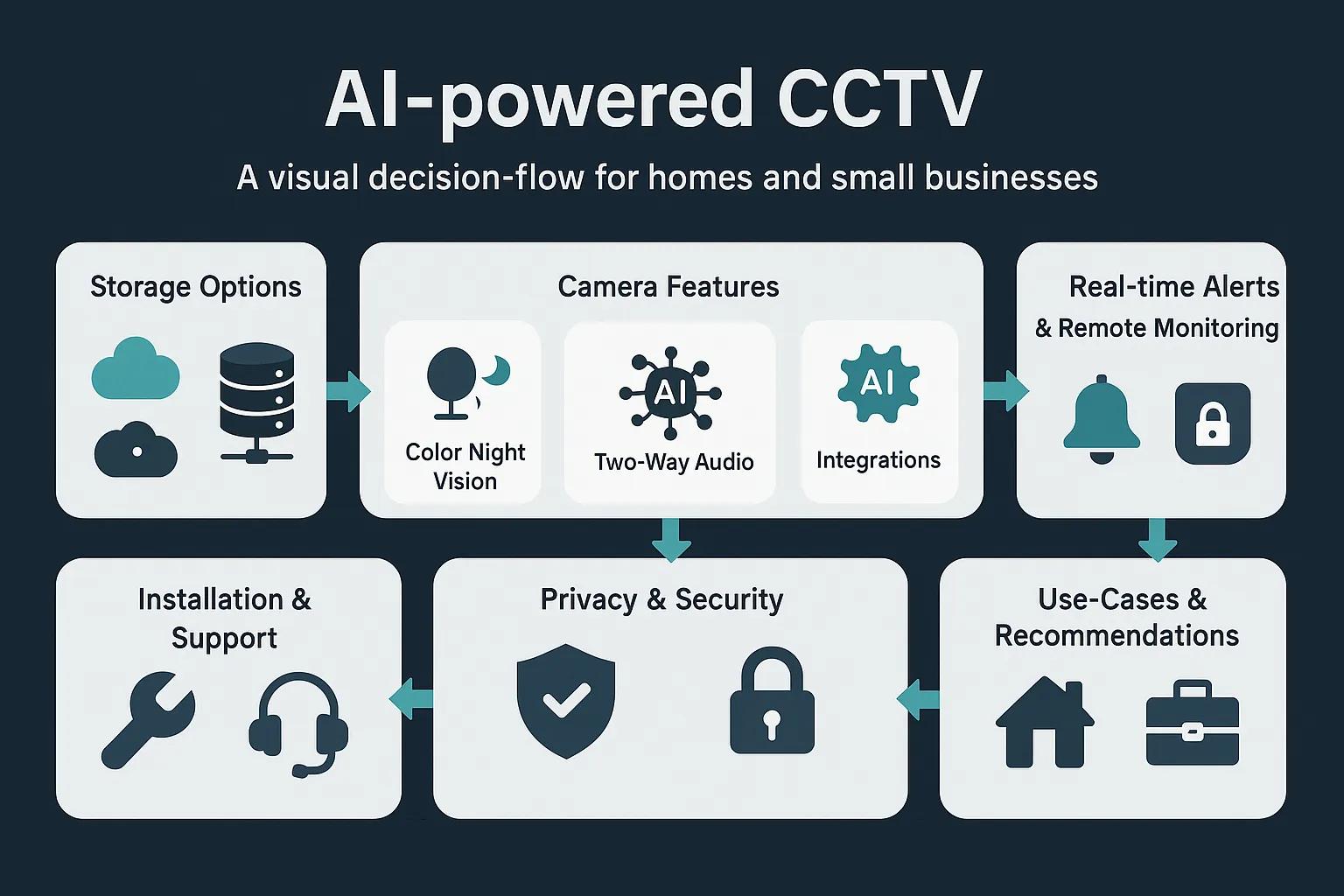
Choosing the right smart CCTV system requires evaluating resolution and sensor type, analytics capabilities, storage strategy, budget constraints, and the level of professional installation and support needed. A structured checklist helps prioritise decisions based on use-case: homes often favour ease-of-use and privacy controls, while businesses weigh scalability and integrations. Consider professional installation when cabling, optimal field-of-view and network configuration are critical, otherwise DIY can work for single-camera setups. Below is a practical checklist and scoring approach to guide selection.
Use this checklist to evaluate against your priorities.
- Resolution & sensor quality: Higher resolution improves identification at distance.
- Analytics: Confirm person/vehicle/package detection and false-positive rates.
- Storage plan: Choose cloud, local, or hybrid based on privacy and bandwidth.
- Integration & APIs: Ensure compatibility with your smart-home or enterprise systems.
- Installation & support: Decide between DIY or professional installation based on complexity.
This checklist clarifies core trade-offs and sets the stage for evaluating and provider support, which is critical for many buyers.
How important is installation and support from providers like CTC Communications? Professional installation ensures optimal camera placement, correct cabling, secure network setup and system configuration to minimise blind spots and connectivity issues. For complex installations or multi-camera sites, technician-led deployment reduces configuration errors and ensures integration with existing networks or access-control systems. CTC Communications, identified as a provider of CCTV installations and smart CCTV security systems, can assist with quotes and assessments to match analytic capabilities and storage strategies to local needs. Homeowners and businesses should ask providers about local support coverage, warranty terms and response SLAs when comparing options.
Questions to ask :
- What is included in the installation scope and configuration?
- How is firmware and analytics model updating handled?
- What support and SLA options are available for downtime or incidents?
These provider-focused decisions lead naturally into emerging trends shaping future CCTV capabilities.

What Are the Emerging Trends in Smart CCTV for 2025 and Beyond?
Emerging trends include predictive analytics that identify behavioural anomalies over time, stronger privacy-preserving technologies such as on-device processing and privacy zones, and deeper integration with smart home and city-scale IoT platforms. Advances in model efficiency and edge processing allow richer analytics without constant cloud dependency, enabling lower-latency alerts and reduced data exposure. These developments will broaden CCTV applications while raising important ethical and regulatory questions about surveillance and data use. The following subsections examine predictive analytics, privacy and ethics, and broader integration trajectories.
Predictive analytics
Predictive analytics in applies pattern recognition across temporal sequences to surface anomalies that suggest pre-incident behaviours, such as prolonged loitering patterns that historically precede thefts. When combined with human review, predictive models can provide early warnings and enable preventative actions, but they introduce higher false-positive risks that must be managed through model tuning and feedback loops. Current limitations include data quality, bias mitigation and the need for robust human-in-the-loop processes. Addressing these limitations is essential before predictive systems are relied upon for automatic enforcement.
Privacy and ethical considerations
Privacy and ethical considerations remain central as smart CCTV becomes more capable: transparent signage, consent for recorded areas, data minimisation, retention policies and access controls are baseline requirements for responsible deployment. Technical mitigations such as on-device processing, privacy zones, selective blurring and encrypted storage reduce unnecessary exposure of personal data. Local and regional compliance frameworks should guide retention and sharing practices, and system designers must prioritise auditability and transparency to maintain community trust. These privacy safeguards matter when integrating CCTV across broader smart ecosystems.
Broader integration trajectories
Smart CCTV will continue to integrate with broader smart home technologies via robust APIs, hubs and cloud services, enabling coordinated automations such as lighting and lock control in response to verified events. Future possibilities include tighter energy and safety integrations — for example, thermostats and lighting responding to occupancy analytics — while caution is needed to manage the expanded attack surface that cross-system integrations create. Best practices include segmented networks, strict authentication, and limiting integration privileges to necessary functions, ensuring coordinated convenience does not compromise security.
Emerging trend takeaways:
- Predictive analytics offers proactive alerts but needs human oversight.
- Privacy-by-design is essential for responsible adoption.
- Secure integrations enable richer automations while increasing risk.
This article ends here with the last planned .
Frequently Asked Questions
1. How does AI improve the functionality of smart CCTV systems?
AI enhances smart CCTV systems by enabling real-time analytics that classify and prioritize detected activities. This technology allows the system to differentiate between normal movements, such as pets or foliage, and potential threats, significantly reducing false alarms. By analyzing motion patterns and recognizing familiar faces, AI can provide actionable alerts, ensuring that homeowners are only notified of relevant events. This proactive approach not only improves security but also streamlines monitoring efforts, making it easier for users to manage their surveillance systems effectively.
2. What are the key differences between local and cloud storage for CCTV footage?
Local storage involves keeping CCTV footage on-site, typically using a Network Video Recorder (NVR) or Digital Video Recorder (DVR). This method offers greater control and privacy but is vulnerable to theft or hardware failure. In contrast, cloud storage provides off-site redundancy, centralized management, and easier remote access, enhancing data resilience. However, it may involve ongoing subscription costs and potential privacy concerns. Many users opt for hybrid solutions, combining both local and cloud storage to balance immediate access with off-site backup for added security.
3. What should I look for in terms of camera resolution and sensor quality?
When selecting a smart CCTV camera, prioritize high resolution and quality sensors to ensure clear image capture, especially at a distance. Higher resolutions, such as 1080p or 4K, provide better detail for identifying faces, license plates, and other critical features. Additionally, look for cameras with advanced sensor technology that performs well in low-light conditions, such as those equipped with color night vision. This combination enhances the overall effectiveness of your surveillance system, allowing for better monitoring and evidence collection during both day and night.
4. How can I ensure my smart CCTV system is secure from cyber threats?
To secure your smart CCTV system from cyber threats, implement strong passwords and change default credentials immediately. Regularly update firmware to patch vulnerabilities and enable encryption for data transmission. Use network segmentation to isolate your CCTV system from other devices on your home network, reducing the risk of unauthorized access. Additionally, consider using a Virtual Private Network (VPN) for remote access and limit integration with third-party applications to only those that are necessary. These practices help safeguard your surveillance system against potential cyber attacks.
5. What are the benefits of two-way audio in smart CCTV systems?
Two-way audio in smart CCTV systems allows for real-time communication between users and individuals on-site, enhancing security and convenience. This feature enables homeowners to deter potential intruders by speaking directly through the camera, providing immediate intervention capabilities. It also facilitates communication with delivery personnel or service workers, allowing users to give instructions without being physically present. The ability to interact remotely adds a layer of control and reassurance, making two-way audio a valuable feature for enhancing home security and user engagement.
6. How do smart CCTV systems contribute to crime prevention?
Smart CCTV systems contribute to crime prevention by providing real-time alerts and enabling immediate verification of suspicious activities. With features like motion detection and AI analytics, these systems can identify potential threats and notify homeowners or monitoring services promptly. The presence of visible cameras often acts as a deterrent to criminals, reducing the likelihood of theft or vandalism. Additionally, recorded footage serves as valuable evidence for investigations, helping law enforcement address incidents more effectively and enhancing overall community safety.
7. What should I consider regarding installation and support for my CCTV system?
When considering installation and support for your CCTV system, evaluate whether you need professional assistance or if a DIY approach is feasible. Professional installation ensures optimal camera placement, secure network setup, and proper configuration, which is crucial for complex systems. Additionally, inquire about the support options provided by the installer, including warranty terms, response times for service requests, and ongoing maintenance. Understanding these aspects will help you choose a reliable provider and ensure your system operates effectively over time.
1. What factors should I consider when choosing a smart CCTV system?
When selecting a smart CCTV system, consider factors such as resolution and sensor quality, analytics capabilities, storage options (cloud, local, or hybrid), budget constraints, and the level of professional installation required. It's essential to prioritize features based on your specific needs, whether for home security or business operations. For instance, homeowners may focus on privacy and ease of use, while businesses might prioritize scalability and compliance with regulations. A structured checklist can help guide your decision-making process.
2. How do smart CCTV systems handle privacy concerns?
Smart CCTV systems address privacy concerns through various measures, including on-device processing, privacy zones, and selective blurring of faces or sensitive areas. These features help minimize unnecessary exposure of personal data. Additionally, responsible deployment requires transparent signage, consent for recorded areas, and strict data retention policies. Users should also ensure that their systems comply with local regulations regarding surveillance and data protection to maintain community trust and safeguard individual privacy rights.
3. Can I integrate my smart CCTV system with other smart home devices?
Yes, many smart CCTV systems offer integration capabilities with other smart home devices through APIs and hubs. This allows for coordinated automations, such as turning on lights or locking doors in response to verified events detected by the CCTV system. Integration enhances the overall security and convenience of your home. However, it's crucial to implement best practices, such as network segmentation and strong authentication, to mitigate potential security risks associated with interconnected devices.
4. What are the advantages of using cloud storage for CCTV footage?
Cloud storage for CCTV footage provides several advantages, including off-site redundancy, centralized management, and simplified sharing for investigations. It protects footage from local theft or hardware failure through encrypted uploads and managed retention policies. Additionally, cloud storage allows for easy remote access to footage from authorized devices, enhancing the ability to monitor security in real-time. However, users should weigh these benefits against potential privacy concerns and ongoing subscription costs associated with cloud services.
5. How can real-time alerts improve home security?
Real-time alerts significantly enhance home security by enabling immediate verification and intervention during potential incidents. These alerts can be sent via push notifications, SMS, or email, often including video clips or snapshots for quick assessment. This allows homeowners to respond promptly, whether by deterring intruders through two-way audio or notifying neighbors or authorities. The ability to act quickly can prevent crime and reduce loss severity, making real-time alerts a crucial feature of modern smart CCTV systems.
6. What role does AI play in reducing false alarms in smart CCTV systems?
AI plays a critical role in reducing false alarms in smart CCTV systems by employing advanced analytics to classify movement and detect relevant activities. Instead of merely measuring pixel changes, AI can differentiate between people, pets, and environmental factors like shadows or foliage. This classification helps filter out non-threatening movements, ensuring that only significant events trigger alerts. As a result, homeowners experience fewer false alarms, leading to improved focus and efficiency for monitoring personnel.
7. What are the emerging trends in smart CCTV technology for the future?
Emerging trends in smart CCTV technology include the development of predictive analytics that can identify behavioral anomalies, stronger privacy-preserving technologies, and deeper integration with smart home and city-scale IoT platforms. These advancements aim to enhance the capabilities of CCTV systems while addressing ethical and regulatory concerns. As technology evolves, we can expect more efficient models that require less cloud dependency, enabling faster alerts and improved data security, all while maintaining user privacy and trust.
Conclusion
Investing in smart CCTV systems enhances home security through proactive threat detection, reduced false alarms, and structured evidence collection. These advanced features not only provide peace of mind but also empower homeowners to respond swiftly to incidents. By understanding the unique benefits of AI-powered surveillance, you can make informed decisions tailored to your security needs. Explore our range of smart CCTV solutions today to elevate your home security.